Before you redesign your website, talk to real customers. Not an AI.
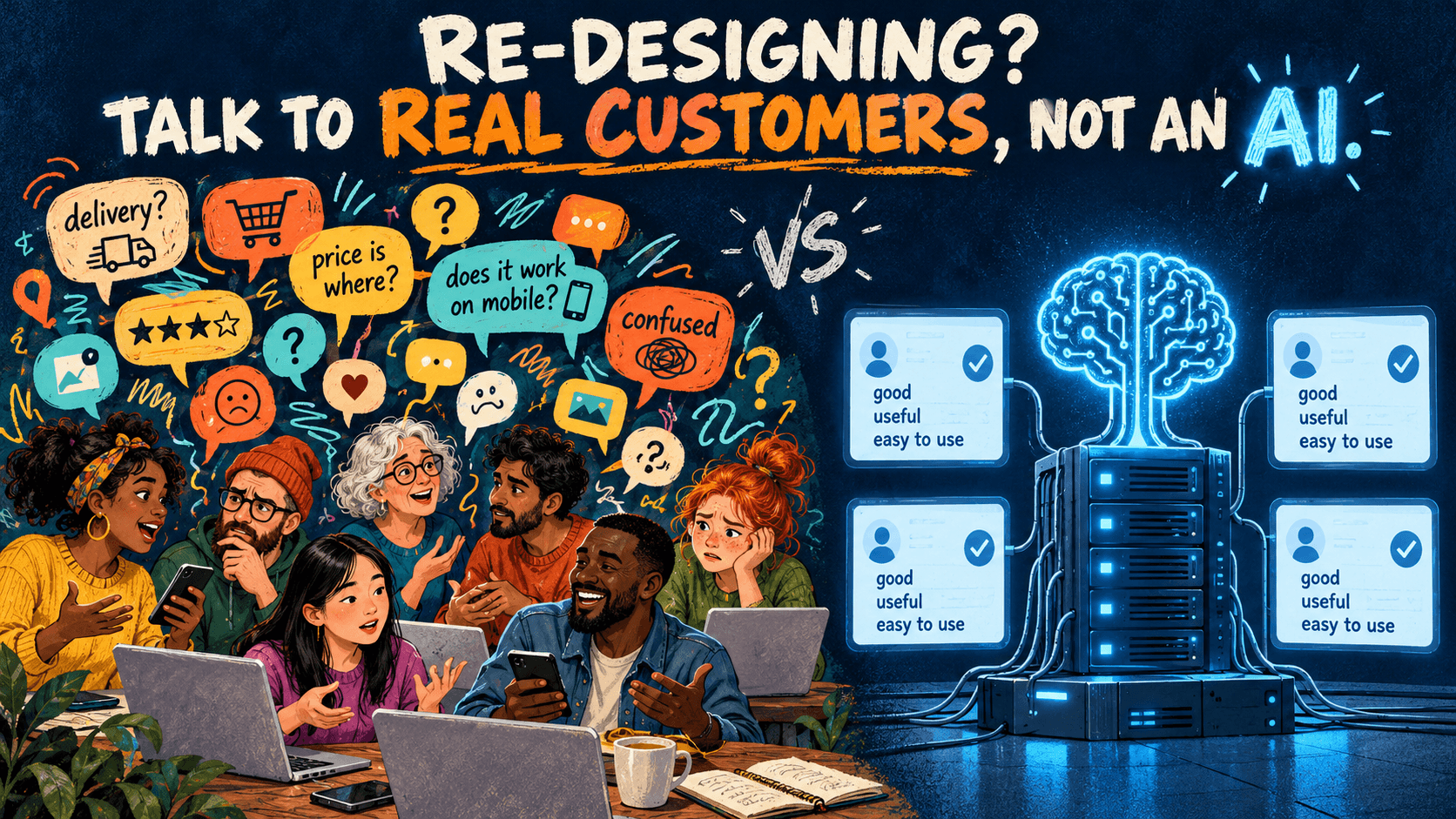
It is tempting to outsource user discovery to large language models.
You prompt a persona, simulate five hundred customer interviews in thirty seconds, and watch the summaries roll in without spending a rupee on recruitment incentives.
It feels like magic, but it is actually a trap.
Nielsen Norman Group, a pioneer in UX research, ran an experiment to test this shortcut. They asked 604 real people a simple question about how they define and perceive UX work. Then, they asked 120 AI-generated personas the exact same question.
On the surface, the results looked reassuring: the primary, high-level theme matched across both groups. But look closer, and the illusion shatters.
The real human participants produced over 50 distinct, nuanced variations. The AI respondents collapsed into roughly a dozen tidy, predictable themes.
Here is what most teams miss: the dominant answer was never the problem. The loss of variety is what quietly destroys conversion rates.
When you build solely for the consensus, you design for an imaginary persona, the statistical average. But real websites do not fail on the common paths; they leak revenue at the edges.
The drop-offs happen because of the odd, unscripted realities that synthetic users never bring up:
- The buyer who abandoned their cart because your delivery estimate felt unrealistic for their pin code.
- The customer who couldn't find the total landed cost before typing in their card details.
- The user navigating on a spotty mobile connection who grew impatient waiting for a heavy script to render.
- The returning customer who simply wanted to reorder an item but was forced through a redesign that buried their order history.
An AI will never tell you these things, because LLMs are fundamentally predictive engines trained to output the most probable tokens.
By design, they smooth over the rough edges, the quirks, the specific anxieties, and the irrational friction that real human beings experience every single day.
AI is not useless in UX work, but its place is in preparation, not validation.
Use it to audit your interview guides, identify potential blind spots, roleplay difficult objections, or synthesize transcripts after the fact.
Then close the tab, pick up the phone, and talk to actual human beings before you move a single pixel.
AI can give you the average. Your customers aren't average.
Published: October 19, 2026
Last updated: 2026-05-27
Sources