WhatsApp updates Business API Pricing in India from 1st October
A few months back, a client asked me a question that sounded simple but wasn't: "Kailash, we're sending order updates on WhatsApp now. why did this month's bill jump when we didn't send more messages?"
That one question led us down a rabbit hole of Meta's pricing documentation, tier calculations, and template categories. And honestly? Most business owners in India are running WhatsApp campaigns without really understanding what they're being charged for or why.
So, let's fix that. No jargon, no fluff. Just what you actually need to know before you send your next WhatsApp template message.
First, forget everything you knew about "conversation pricing"
If you looked into WhatsApp Business API pricing even a year or two ago, you probably read about "conversation windows", where Meta charged you once for a 24-hour window of messaging, no matter how many messages went back and forth.
That model is gone. Since July 1, 2025, Meta shifted to per-message pricing. You're now charged individually for each template message you send, not for a whole conversation.
It's a cleaner model, but it also means the old mental math your agency or vendor may have taught you no longer applies.
The messages that don't cost you a rupee
Here's the good news first, because there's more free stuff here than most businesses realize.
- Regular messages are free. If a customer messages you first and you reply with a normal text, image, or any non-template message, it costs nothing, as long as you're replying inside the 24-hour customer service window (CSW) that opens when they write to you.
- Utility templates inside that same window are free too. So, if a customer asks about their order and you send them a utility template (like an order confirmation) while that window is still open, you don't pay for it.
- The 72-hour "free entry point"(FEP) window. If someone messages you through a Click to WhatsApp ad or a Facebook Page button, you get a 72-hour window where everything you send them, even template messages, is free.
This is a big deal if you're running WhatsApp-driven ad campaigns, because it rewards you for converting ad clicks into conversations.
Now, what you actually pay for
Templates are where the real cost sits, and Meta splits them into three buckets:
- Marketing templates: promotional messages, offers, new product announcements. These are always charged, every single time, whether or not a conversation window is open.
- Utility templates: order confirmations, shipping updates, appointment reminders, ecommerce status updates, Free if sent inside an open customer service window, charged if sent outside it (say, a shipping update three days after the customer last messaged you).
- Authentication templates: OTPs and login verifications. These have their own pricing, and for a few countries, India included, there's a separate, usually higher "authentication-international" rate that applies depending on the recipient.
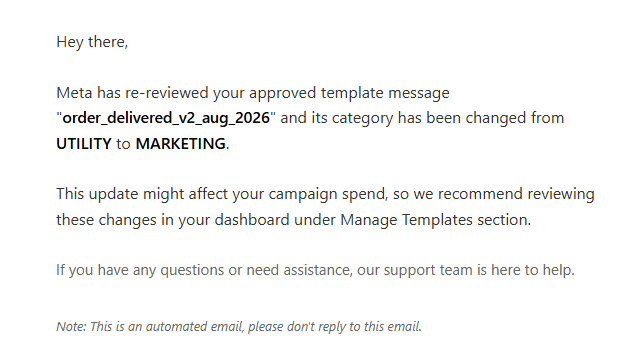
Here's the part that trips people up: a template's category isn't something you casually choose.
Meta assigns and reviews it, and whatever category your approved template carries is what determines your charge every time you use it.
This is exactly why we're strict about template categorization when we set these up for clients, get it wrong at approval stage, and you're paying marketing rates for what should've been a utility message.
A quick example, the way Meta actually walks through it
Imagine you're running a small D2C brand, T-shirts, sarees, doesn't matter.
- You send a marketing template announcing a new product. Charged.
- The customer replies asking about it. This opens a 24-hour window(CSW). No charge for their message.
- You reply with a plain text message explaining details. Free, because it's a non-template message inside the window.
- They buy, and you send a utility template message confirming the order. Free, because the window is still open.
- Two days later, window's closed now you send a utility template with a shipping update. You’ll be Charged, because there's no open window anymore.
Out of four business messages sent, only two were actually billed.
That's the kind of nuance that either saves you money or quietly drains your ad budget, depending on whether your automation is built with this logic in mind.
The India-specific bit you shouldn't ignore
Rates aren't flat across the world.
They vary by country, and India has its own line on Meta's rate card.
Over the past year, India specifically saw a higher marketing message rate take effect from January 1, 2026, and a higher authentication-international rate from April 1, 2026.
Meta also updates pricing only on the first day of a quarter (Jan, Apr, Jul, Oct) and gives advance notice ranging from one month for simple rate changes to six months for a full pricing-model overhaul.
Quick Note: if you're budgeting for WhatsApp marketing this year, don't just copy last quarter's numbers. Check the current rate card, because it will have moved.
Sending in volume? There's a reward for that
If your business sends a serious number of utility or authentication messages every month, Meta has volume-based tiers that unlock lower rates as you cross certain thresholds, tracked per market and per category, and reset every month.
It's Meta's way of rewarding businesses that use WhatsApp at scale rather than penalizing them for it.
But this only matters once you're sending real volume.
For most small and mid-sized Indian businesses just starting out, the bigger win is simply structuring your messages correctly from day one.
Why this matters more than it seems
Here's the honest truth: WhatsApp is probably the highest-attention channel available to Indian businesses right now.
Open rates dwarf email.
Response times beat almost every other channel.
But it's also easy to bleed money on it if your templates are miscategorized, your automation doesn't respect the free windows, or you're firing marketing blasts when a well-timed utility message inside an existing window would've done the job for free.
We've seen this firsthand running WhatsApp automation for our e-commerce clients: order confirmations, delivery updates, COD-to-prepaid nudges, review requests. The businesses that treat WhatsApp pricing as an afterthought end up paying for messages they didn't need to.
The ones that plan around the free windows and correct template categories get the same customer reach for a fraction of the cost.
Current India rates (excl. GST):
- Marketing: ₹0.8631/message
- Utility (outside free window): ₹0.115
- Authentication (domestic): ₹0.115
- Authentication-international: ₹2.4971
Upcoming changes flagged:
- Jan 1, 2026: marketing rate already rose ~10% (₹0.7846 → ₹0.8631)
- Aug 1, 2026: Meta Business Agent (Meta's own AI replies) moved to token billing, $2/million tokens
- Oct 1, 2026: the big one: free-form service messages and in-window utility templates both become chargeable, at roughly the same rate as utility templates today (~₹0.115 in India, exact number confirmed by Meta by Sep 1, 2026)
New free tier: 1,000 service messages per business phone number per month, then billable. - Businesses without a payment method on file by Sep 30, 2026 will have service message delivery paused once charges start
- 72-hour free entry point window (Click-to-WhatsApp ads, Page CTA) stays untouched, good hook for your paid-to-WhatsApp campaign clients
Let BrandMen Studio set this up right for you
If you're running a business in Andhra Pradesh or anywhere in India, and you're using WhatsApp for order updates, marketing, or customer support, this is exactly the kind of thing we help with at BrandMen Studio.
We design and build the entire WhatsApp automation layer: template structuring, category planning, AiSensy and API integrations, and workflows that make sure you're using free windows to your advantage instead of accidentally paying marketing rates for what should be routine service messages.
We're not here to just "run your WhatsApp." We're here to make sure every message you send is doing its job and doing it at the right price.
Reach out to us at hi@brandmen.io or check out brandmen.io to see how we can set up your WhatsApp Business Platform the smart way.
Published: September 2, 2026
Last updated: 2026-05-27